Models
Add local models, foundation-model APIs, or hybrid routes. Switch task by task.
- Local llama.cpp style runtime
- Model readiness states
- Task-specific model selection
 Product System
Product architecture
Cenedril is the control layer.
Local models, assigned agents, owned data, and visible permissions in one operational console.
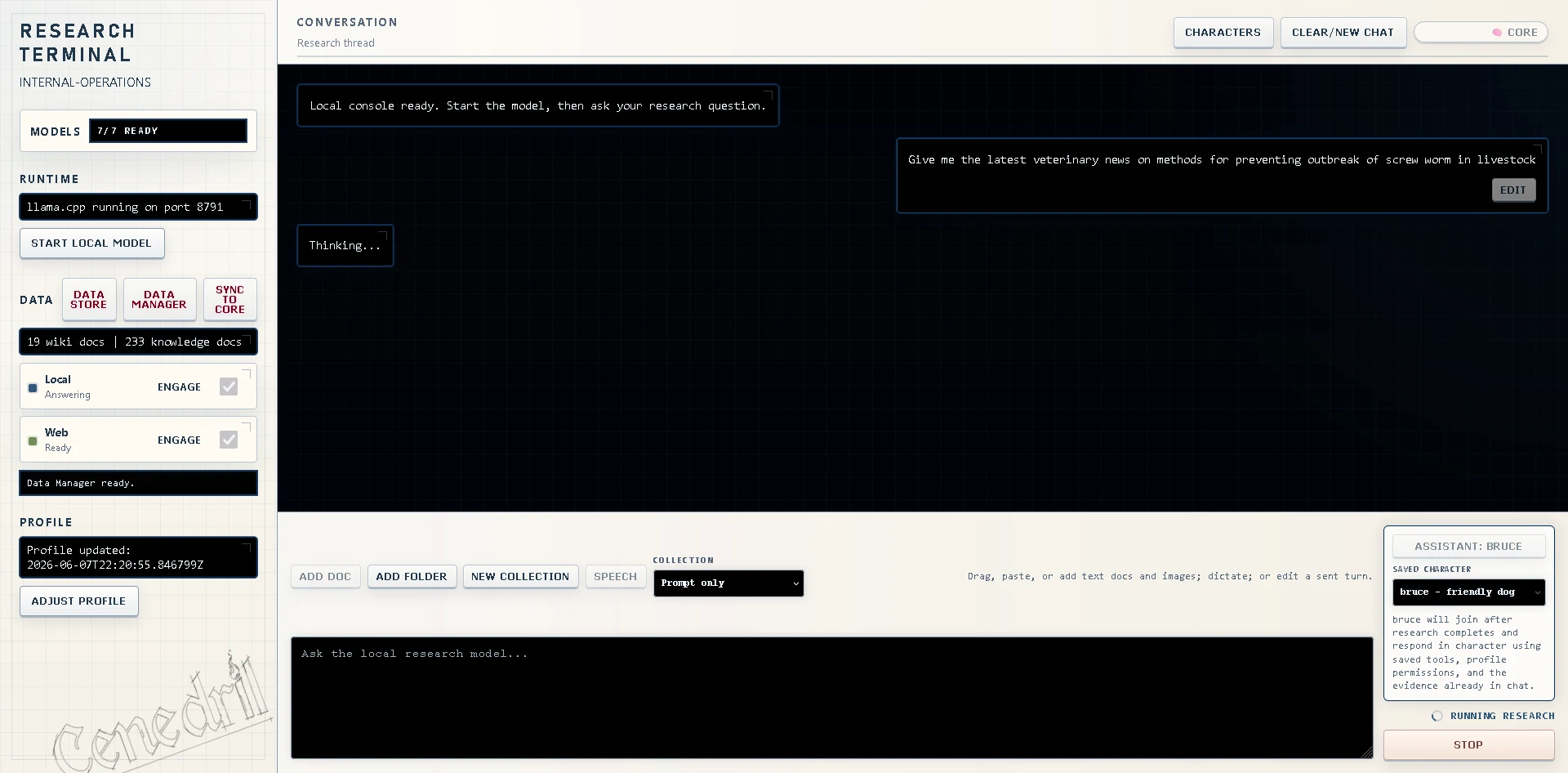
Cenedril gives operators a visible console for models, agents, data stores, tool access, and research history. The core design principle is simple: keep the system inspectable, shapeable, and close to the work.
Models: 7/7 ready · Data: 19 wiki docs + 233 knowledge docs · Agent: bruce — friendly dog
Interface principles
Every model, agent, collection, data source, and web connection should have a visible state. The operator can engage, disengage, or change context without losing the thread.
Capability matrix
Add local models, foundation-model APIs, or hybrid routes. Switch task by task.
Create named assistants, assign models, and preserve role-specific instructions.
Bring the knowledge that matters: documents, PDFs, folders, records, archives.
Make data access visible so the operator can govern every research run.
Run where internet is weak, risky, or unavailable when models and data are local.
Keep evidence, source state, and operator choices attached to the work.
Friendly research assistant · local model · saved profile
Low-connectivity research and checklist mode
Strategic synthesis for C-suite conversations
Multi-model agents
A legal research agent, field operations agent, sales intelligence agent, and workshop assistant should not all need the same model, memory, or web access. Cenedril makes those choices explicit.
Offline-ready operations
When the relevant models and data are local, Cenedril can support research and decision assistance in places where the internet is unavailable, unreliable, expensive, or inappropriate.
Run research archives and operating manuals far from stable connectivity.
Use a local knowledge package for mobile teams, maintenance crews, or survey routes.
Preserve plans, checklists, contacts, and procedures when networks degrade.
Keep facility-specific documentation available where signal is weak.